Preview

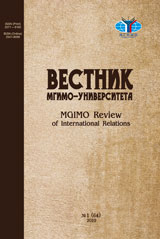
MGIMO Review of International Relations

Advanced search

Journal’s description

The MGIMO Review of International Relations is a peer-reviewed journal on international relations. The Journal’s main goals and objectives are:

  1. To publish original research on international relations: contemporary international political science, history of international relations, regional studies, global and regional governance, as well as world economy and international political economy. Particular attention is dedicated to the analysis of the Russia’s role in the international system and the system’s impact on Russia.
  2. To further develop the Russian School of International Relations. The journal seeks to consolidate and promote this School worldwide. The School has largely been formed around the Moscow State Institute of International Relations (MGIMO-University), its professors and graduates. MGIMO-University is home for the Russian International Studies Association (RISA, Russian branch of International Studies Association, ISA). Academician Anatoly V. Torkunov, the Rector of the University and the chief editor of our journal, is the President of RISA. The Russian School of international relations combines the following areas of research: world politics, history of international relations, applied analysis of international problems, regional studies, as well as global governance. At the normative level the school supports the democratic organization of international relations. It emphasizes the value of cultural and civilizational diversity, as well as pluralism in ways of studying, understanding and managing international relations. Methodologically it is based primarily on qualitative research methods.
  3. To promote international scientific discussion and communication among scholars working within the framework of the Russian School of International Relations. These scholars work in major international relations research centers both in Russia and abroad (USA, Canada, Great Britain, Germany, France, China, etc.) and publish their academic papers both in Russian and in English.

Subject Area and Subject Category

The MGIMO Review of International Relations publishes articles in the subject category «Political Science and International Relations» within subject area «social sciences». Following the development of the Russian school of International Relations the journal «MGIMO Review of International Relations» focuses primarily on the following themes within the subject category «Political Science and International Relations»:

  • international politics,
  • history of international relations,
  • theory of international relations,
  • international political economy,
  • regional studies,
  • international security,
  • global governance.

The emphasis is given to international politics, history of international relations and international political economy.

International law is not included in the journal’s scope. We also do not welcome articles on comparative politics. We publish them only if the problems raised reflect regional or global trends.

Geographical Scope

The MGIMO Review of International Relations has a wide geography of authors, editorial board members and reviewers. We receive articles and citations from Armenia, Australia, Austria, Canada, Finland, Germany, Great Britain, Kazakhstan, Mexico, Poland, Serbia, Slovakia, South Korea, Switzerland, Ukraine, USA. Recently the journal has become popular among scholars from Iran and Turkey.

The editorial board consists of outstanding specialists in international relations from all over the world. More than one third of the editorial board are international scholars and they either belong to the Russian school of International Relations or study Russia in the context of international relations (USA, UK, France, Serbia, Bulgaria).

The rest of the members are scientists who represent the Russian school of International Relations in the leading think-tanks from all over Russia (Moscow, St. Petersburg, Nizhny Novgorod).

Current issue

Vol 19, No 4 (2026)
View or download the full issue PDF (Russian)

RESEARCH ARTICLES. International Political Economy

7-35 659
Abstract

This article develops a framework for translating global science and technology trends into priorities for regional development in Russia. The framework combines three analytical dimensions: global technological dynamics, federal priorities under National Projects for Technological Leadership, and the scientific, industrial, institutional, and investment capacity of regions. Its purpose is to avoid both mechanical imitation of global trends and inwardlooking regional planning. The analysis uses publication and patent data from Lens.org and compares two contrasting fields: “New Materials and Chemistry,” a broad, mature domain, and regenerative biomedicine within the project “New Technologies for Health Preservation,” a narrower, emerging field.

For new materials and chemistry, the 2015–2025 dataset contains 9 654 500 publications. Annual output increased from 778 554 publications in 2015 to 1 102 498 in 2024, with recent annual growth approaching zero. The patent dataset for 2017–2025 comprises 9 609 853 documents and is dominated by large corporate applicants. China leads publication activity, whereas both China and the United States occupy leading positions in patenting. Taken together, these indicators suggest that the field as a whole has moved beyond emergence and early practical validation toward a more mature stage of commercialization or industrial use, although individual technological niches remain heterogeneous.
Regenerative biomedicine displays a different trajectory. Publications increased from 426 in 2015 to 2 509 in 2024, a rise of 488 percent, while patents grew from 235 to 630, or 168 percent. The combination of rapid scientific expansion and slower, but sustained, patent growth identifies the field as emerging, with substantial potential to advance toward practical application. Claims about market growth, however, require separate investment and market data.

The regional component is illustrated through Rostov Oblast and micro- and small-tonnage chemistry, particularly microfluidic synthesis. The case shows how a broad federal priority can be narrowed to a regionally grounded technological niche supported by university infrastructure, workforce development, and industrial partnerships. At the same time, the evidence does not yet establish a fully formed specialization: patents, industrial demand, production volumes, and scaling outcomes require further monitoring. The study therefore concludes that publication and patent analysis is most useful as an initial screening instrument within a broader, place-based priority-setting process.

36-60 600
Abstract

Prompted by the 2025 Nobel Prize in Economic Sciences awarded to Joel Mokyr, Philippe Aghion, and Peter Howitt, this article asks how sustained innovation-driven growth can be explained by integrating endogenous growth theory with cultural and institutional analysis of knowledge production. It traces the shift from exogenous technological change to the Schumpeterian Aghion–Howitt framework and compares that framework with Mokyr’s concept of a “culture of growth.” Methodologically, it combines comparative analysis of models, reconstruction of mechanisms, and a critical review of historical and empirical research on innovation, competition, human capital, institutions, and technological diffusion.
The analysis shows that the Aghion–Howitt framework explains growth as an endogenous sequence of quality-improving innovations generated by R&D investment. Successful innovators obtain temporary monopoly rents, while each new technology displaces the previous one, producing “creative destruction.” Later extensions link innovation intensity to technological gaps between leaders and followers and explain the inverted-U relationship between competition and innovation: moderate competition may encourage firms to “escape competition,” whereas excessive pressure can reduce expected returns to research for lagging firms. Evidence supports the importance of R&D, firm entry and exit, resource reallocation, human capital, institutional quality, and distance to the technological frontier, but shows that their effects vary across countries, industries, and stages of development.
Mokyr addresses a historical question: why some societies became capable of producing, transmitting, and applying useful knowledge. His approach identifies intellectual openness, competition among ideas and jurisdictions, mobility, research autonomy, and institutions for preserving and disseminating knowledge as conditions that can turn isolated inventions into sustained technological progress. The article argues, however, that Mokyr’s cultural variables are difficult to operationalize and risk generalizing a European historical trajectory. Conversely, formal growth models simplify technological coexistence, the role of the state, international dependence, and the institutional diversity of innovation systems.
The conclusion is that these approaches do not constitute a single theory. Together, they form a multilevel research program linking cultural and institutional preconditions for knowledge creation, microeconomic incentives for innovation, and macroeconomic growth. This synthesis explains why neither market incentives, state coordination, nor cultural openness alone is sufficient to account for long-run technological development.

61-82 591
Abstract

Digitalization and the expansion of cross-border exchanges involving information and communication technology (ICT) are becoming increasingly important for the modern global economy. The Gulf Cooperation Council (GCC) countries are actively involved in this process and seek to use digital technologies to diversify economies that remain dependent on hydrocarbon exports. This article examines the scale, dynamics, commodity structure, geographical orientation, and principal constraints of GCC trade in ICT goods and ICT services during 2015–2024. It distinguishes such trade from digital trade, which is defined by international statistical standards as trade that is digitally ordered and/or digitally delivered. The empirical analysis is based primarily on UNCTADstat data and applies comparative and descriptive analysis of time series, growth rates, trade balances, and country shares. Since 2024 data on ICT goods are available only for Saudi Arabia and the United Arab Emirates, 2015–2023 is the latest fully comparable period for the six GCC economies. During this period, GCC exports of ICT goods increased from US$8.555 billion to US$46.665 billion, or 5.45 times, while imports rose from US$33.101 billion to US$82.483 billion, or 2.49 times. The corresponding world increases were 1.42 and 1.41 times. The GCC share of world ICT-goods exports rose from 0.46% to 1.75%, and its share of imports from 1.60% to 2.84%. The regional trade deficit in ICT goods nevertheless widened from US$24.546 billion to US$35.818 billion, although the export-toimport coverage ratio improved from 25.8% to 56.6%. The results also reveal strong country differentiation. In 2023, the UAE accounted for 91.6% of GCC ICT-goods exports and 75.9% of imports; West Asia received 73.8% of regional exports. Data on ICT services are less complete and cover only Bahrain, Kuwait, Oman, and the UAE. Bahrain, Kuwait, and the UAE recorded positive balances in the reported years, whereas Oman had deficits from 2020 to 2023. The findings indicate rapid but highly concentrated growth, accompanied by continuing import dependence, uneven national capacities, and incomplete regional statistics. Greater policy coordination, statistical transparency, investment in skills, research, and domestic production would strengthen the contribution of ICT trade to economic diversification across the six member states collectively over time.

RESEARCH ARTICLES. International Security

83-101 600
Abstract

This article examines the foreign and defence policy of the Trump administration in light of the new U.S. National Security Strategy published in December 2025. It asks whether the administration’s course reflects the preferences of a particular wing of the Republican Party or a broader reassessment of the international environment, the threats facing the United States, and the hierarchy of U.S. national interests. Drawing on classical realism and neorealism, the study combines systemic analysis of the administration’s objectives and instruments with qualitative content analysis of the strategy and public statements by U.S. officials. It also uses elements of scenario-based forecasting to assess how the declared priorities may be translated into policy. The article argues that, despite the President’s frequently contradictory rhetoric and transactional style, the administration’s course displays an underlying strategic logic. Washington is reducing the priority attached to global commitments and concentrating on several interconnected objectives: consolidating U.S. predominance in the Western Hemisphere; containing China in the Indo-Pacific through military alliances, multilateral security arrangements, control of maritime access, and technological competition; restructuring relations with European allies by requiring them to assume a larger share of responsibility for their own defence; limiting direct U.S. involvement in the conflict in Ukraine while preserving the European balance of power; maintaining security commitments in the Middle East without returning to open-ended wars; and retaining U.S. leadership in artificial intelligence, space systems, biotechnology, quantum technologies, and advanced defence capabilities. The article interprets tariff pressure, export controls, demands for higher allied defence spending, the Golden Dome missile-defence initiative, the Stargate artificial-intelligence infrastructure project, and renewed attention to the Arctic as elements of this wider reorientation. Its central conclusion is that the reprioritisation of U.S. national interests is unlikely to end with Trump’s presidency. Although the implementation of individual initiatives may change under domestic and international pressure, the broader shift is rooted in changes in the global balance of power, technological competition, constraints on U.S. resources, and the domestic economic and political situation. These structural factors are likely to influence subsequent administrations regardless of their party affiliation.

102-138 624
Abstract

This article examines how party ideology shapes parliamentary decisions on the use of armed forces abroad. Rather than treating parliament as a single actor, it compares governing and opposition parties. It asks whether a party’s position on the left–right spectrum is associated with its willingness to support a military operation, and whether this relationship changes when the party enters government or when the nature of the operation changes.
The analysis covers 1,022 parliamentary votes in 21 democracies between 1990 and 2019. The sample includes 305 parties and 5,540 party-vote observations. Support is measured as the share of a party’s legislators voting for the proposal; the models distinguish votes on troop deployment from votes on withdrawal. Party ideology is measured using the Manifesto Project and the Chapel Hill Expert Survey. The analysis uses fractional logistic regression and zero-oneinflated beta regression; the latter distinguishes partial support from complete rejection and unanimous approval.
The results show that right-wing parties are more likely than left-wing parties to support military deployments. Some models indicate a nonlinear pattern: both far-left and far-right parties are more restrained than centrist and moderate right-wing parties. The strongest finding concerns institutional status. The relationship between ideology and voting is stronger among opposition parties. Among governing parties, the effect of ideology becomes weaker and, in some models, statistically insignificant. This pattern is consistent with the influence of governmental responsibility, coalition discipline, and electoral risk, although these motivations are not tested.
Results for operation type are less consistent. Operations involving intense combat do not widen the ideological divide. Support roles – training, defense cooperation, and logistical assistance – receive stronger backing from right-wing parties in some models. Humanitarian operations attract broader support and narrow the gap between left- and right-wing parties, but these effects depend on the sample and the measure of ideology. Overall, whether a party governs or remains in opposition explains differences in support for the use of force more consistently across models than the type of operation. By identifying these party-level mechanisms, the study clarifies the domestic political foundations of parliamentary peace and demonstrates why legislatures should not be treated as homogeneous actors.

BOOK REVIEWS

139-151 594
Abstract

Book review: Mirzekhanov V.S., Lannik L.V. 2025. At the Crossroads of Imperial Projects. Pax Ottomanica from the First Constitution to the Treaty of Lausanne. Moscow: Aspect Press.

152-164 656
Abstract

Book review: Tang H., Wong Yue Shun B. (eds.). 2025. Towards a Future for BRICS+. Asia Global Institute / Hong Kong University Press. 216 p.


Creative Commons License
This work is licensed under a Creative Commons Attribution 4.0 License.